

The Constraint That Circulars Cannot Fix
The Philippines’ Islamic finance reform agenda has moved with unusual speed. The Islamic Banking Law of 2019 created the legal architecture; the Securities and Exchange Commission issued a sukuk framework in 2026; the Bangko Sentral ng Pilipinas proposed simplified issuance rules and temporary incentives; and a commercial bank, Maybank Philippines, launched a dedicated Islamic banking unit. Each of those steps removes a formal barrier. None of them creates the human capital required to operate the system.
The talent gap is not a peripheral concern. Research on the Philippine market has identified the lack of skilled and dual-competency professionals—people who understand both conventional finance and Shari’ah jurisprudence—as one of the most significant obstacles to developing a viable Islamic finance sector, with an over-reliance on foreign expertise and a near absence of domestically trained specialists. A bank can obtain a license and build a Shari’ah-compliant product manual, but it cannot outsource the judgment required to certify a structure, audit a profit allocation, or resolve a Shari’ah non-compliance event.
Al-Amanah and MSU: Building the Domestic Pipeline
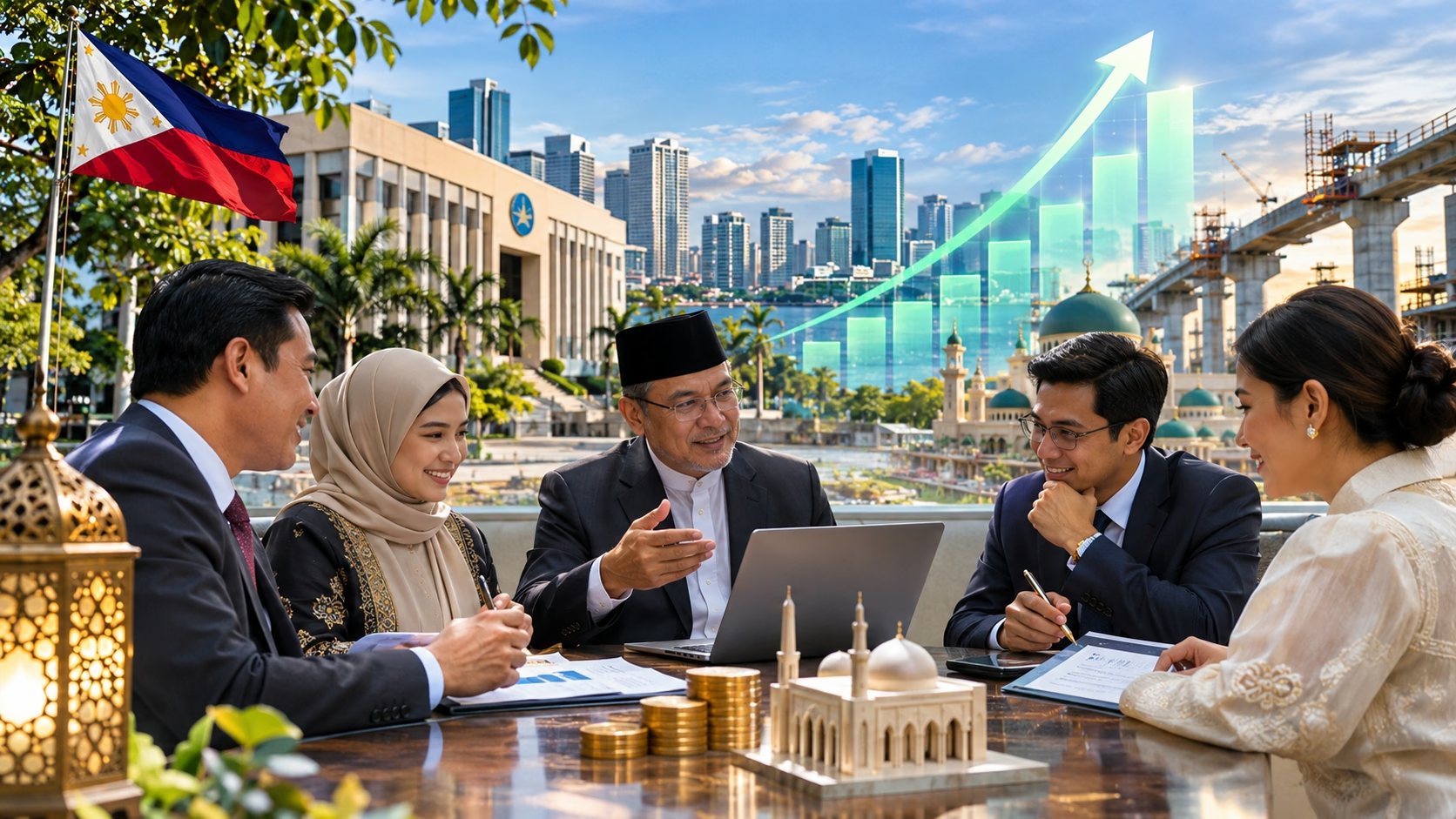
The most concrete institutional response came in October 2026, when Al-Amanah Islamic Investment Bank signed a memorandum of understanding with Mindanao State University (MSU) to offer an Islamic finance course aimed at boosting financial literacy and building academic programs in Islamic banking, finance, commerce, investment, and other Shari’ah-compliant economic activities. The partnership is significant because it locates the training pipeline in Mindanao—the geographic and demographic center of the Philippine Muslim market—rather than in Manila, where most financial-sector training is concentrated.
MSU is not a marginal institution in this context. It is a state university with a long presence in Muslim Mindanao and a student base that can supply the bilingual, culturally grounded talent that Islamic banks need for both technical and client-facing roles. The MOU is a first step rather than a finished solution, but it establishes a domestic pathway for the kind of dual-competency education that the market currently imports.
The BSP’s Capacity Building Architecture
The central bank has approached the talent gap through a coordination model rather than direct provision. The BSP partnered with the Islamic Banking and Finance Institute Malaysia (IBFIM) to train personnel from agencies and stakeholders under the Islamic Finance Coordination Forum (IFCF) in the Associate Qualification in Islamic Finance (AQIF) program. To date, there are 96 AQIF-certified passers in the Philippines, of which 55 are from the BSP and 41 are from other stakeholders under the working group and IFCF.
That is a meaningful but insufficient number. Ninety-six certified professionals cannot staff a banking sector serving a Muslim population of 6 to 10 million, let alone support a sukuk market, a takaful sector, and a growing Islamic banking window presence. The BSP has also launched a basic e-course on Islamic banking and created an Islamic banking webpage, but these are awareness tools rather than professional formation.
Shari’ah Governance as a Skills Problem
The talent constraint is most acute at the Shari’ah governance layer. The SEC’s sukuk framework requires issuers to establish a Shari’ah Committee or appoint a Shari’ah Advisor, certify compliance, and submit an annual Shari’ah report covering the review process, findings, breaches, and purification measures. Each of those requirements depends on individuals who can read a contract, identify riba or gharar, assess the Shari’ah validity of an underlying asset pool, and document their reasoning in a way that satisfies both regulators and investors.
The Bangsamoro Darul-Ifta’s partnership with M&T Consultants explicitly targets this layer, seeking to empower ‘Ulamā and complement their Shari’ah knowledge with Islamic finance auditing, accounting, and advisory skills. The BSP, meanwhile, has issued guidance notes on the submission of requests for Shari’ah opinions of the Shari’ah Supervisory Board, but guidance presupposes the existence of qualified board members.
The Sequencing Problem
The Philippines has sequenced its reforms in the logical order: law first, then capital-market rules, then prudential incentives, then product launches. But talent development operates on a different timeline. A sukuk framework can be drafted in a year; a generation of Shari’ah-compliant bankers and advisors takes a decade. The risk is that the market’s first movers—Maybank, Al-Amanah, and the banks with Islamic windows—will be forced to rely on foreign experts and a thin domestic bench, driving up the cost of compliance and slowing product velocity.
The MSU partnership and the AQIF certification program are the right interventions at the right margin. But they are seeds, not harvests. The Philippines’ Islamic banking opportunity will be determined not by how many circulars it issues but by how many people can read a sukuk prospectus, challenge a profit-sharing ratio, and certify that a structure is genuinely Shari’ah-compliant. That is a slower, less visible project—and it may be the most important one.