
The Languages Global AI Forgot
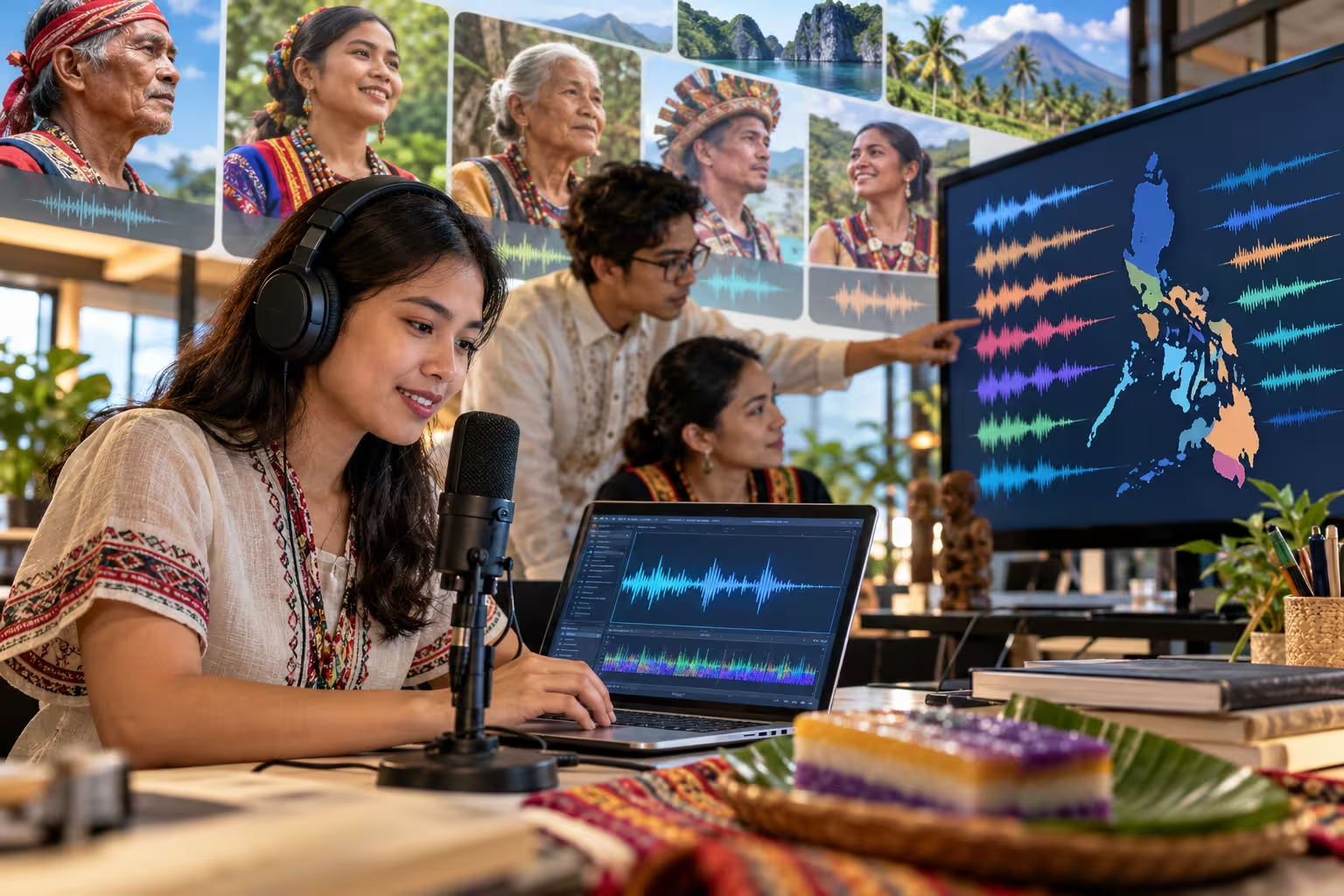
Tagalog and Cebuano dominate Philippine language AI discussions. But Waray, Kapampangan, Pangasinan, Hiligaynon, Bicolano, and Ilocano are spoken by millions of Filipinos—and almost entirely absent from commercial AI models. The Philippine Languages Translation and AI Training Community, known as PLTAT, is a Hugging Face organization dedicated to changing that.
PLTAT’s objective is to bridge the digital divide for low-resource languages through state-of-the-art model alignment, knowledge distillation, and the deployment of efficient, edge-ready AI models. Its technical roadmap is unusually specific for a community project.
Phase 1: Fine-Tuning Llama for Eight Philippine Languages
The first phase focuses on fine-tuning large-scale transformer architectures—Llama 3.1 and 3.2 series—to achieve neural machine translation parity with commercial benchmarks for eight major Philippine languages: Tagalog, Cebuano, Ilocano, Hiligaynon, Bicolano, Waray, Kapampangan, and Pangasinan.
The technical approach uses Supervised Fine-Tuning with high-quality parallel corpora and instruction-tuning datasets, employing QLoRA and full-parameter tuning. The milestone is a validated “Teacher” model capable of high-fidelity translation and complex instruction following—a performance baseline for subsequent distillation.
Phase 2 and 3: Distillation for Edge Deployment
Phase 2 uses the Teacher models to generate synthetic training data for low-resource linguistic variants. This mitigates the scarcity of organic digital text in regional dialects and provides the data density required to train smaller student architectures without performance degradation.
Phase 3 transitions to Liquid Foundation Model architectures to create lightweight, language-specific models in the 1.2B to 3B parameter range, optimized for edge computing and local hardware integration. The end goal is deployment-ready models that can run on mobile devices or environments with limited connectivity.
The Community Call for Partners
PLTAT is actively seeking institutional and technical stakeholders. Its call for partners includes GPU resource provisioning (A100/H100 clusters), domain-specific fine-tuning for legal, medical, and governmental applications, human evaluation and red-teaming by academic and linguistic experts, and deployment integration into mobile applications.
This is not a closed research lab. It is an open infrastructure project with a clear technical roadmap and a specific ask. For Philippine universities, government agencies, and enterprises looking to build on Filipino-language AI without starting from scratch, PLTAT represents a rare opportunity to plug into work that is already underway.
The Broader Stakes: Digital Inclusion Beyond Metro Manila
The Philippine AI startup scene is concentrated in Metro Manila and Cebu. But the languages that need AI the most are spoken in regions with the least access to AI talent and compute. PLTAT’s community model—distributed, open, and technically rigorous—offers a template for how language technology can reach beyond the urban centers where it is typically built.